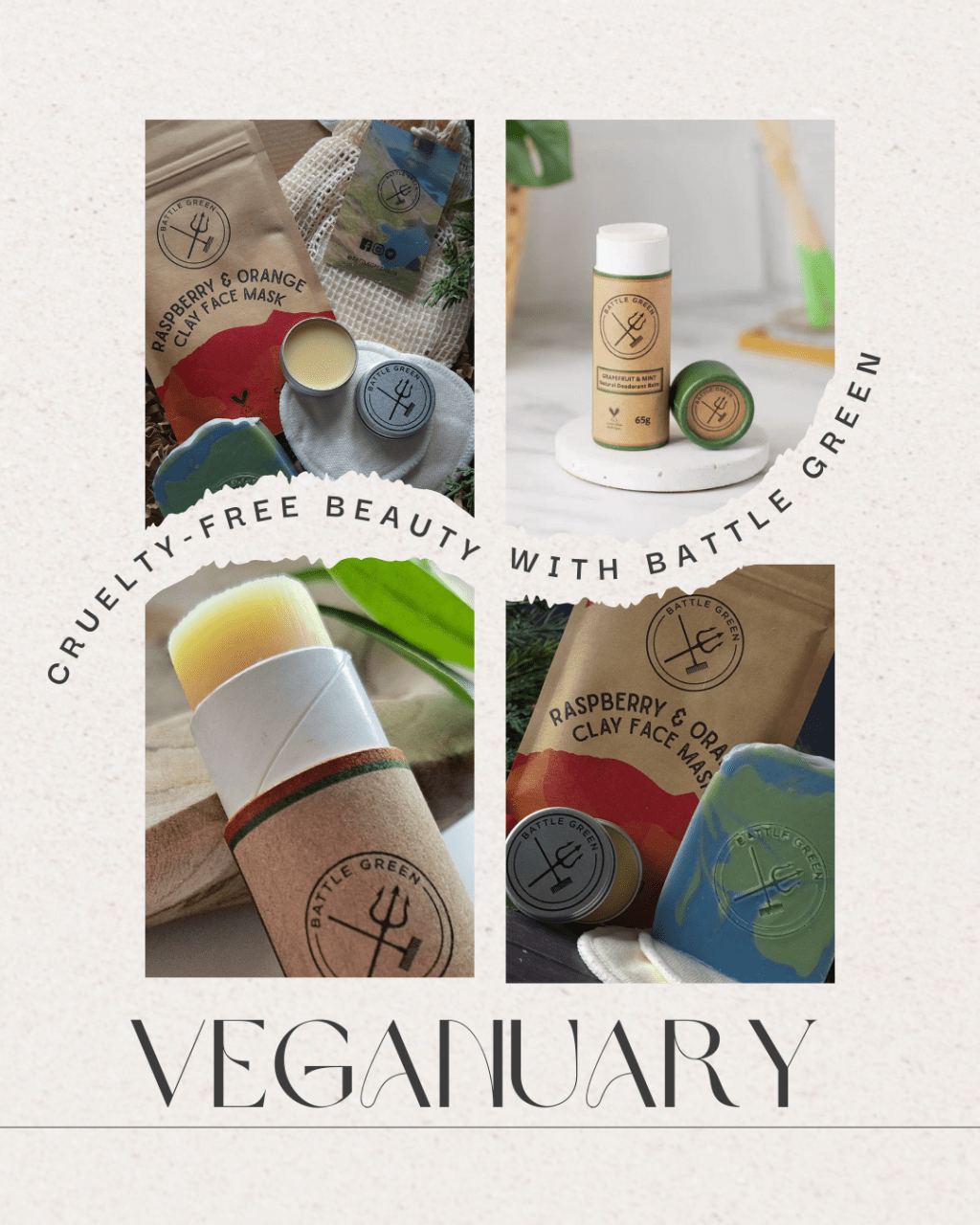
By Lucy, Co-founder of Battle Green
Veganuary: Beyond What You Eat
When you hear “Veganuary,” most people think of food: giving up meat, dairy or other animal-derived ingredients for the month of January. Founded in 2014 by animal activists Matthew Glover and Jane Land, Veganuary has grown into a global movement encouraging people to consider how everyday choices affect animals, the environment and wider values.
But veganism isn’t just about what’s on your plate. Veganuary encourages us to extend this thinking — among other areas — to the products we use every day, from shampoo and deodorant to toothpaste and skincare. Studies show the average woman uses around 16 body-care items daily, and how these products are made is an important part of the ethical conversation.
Cruelty-Free vs Vegan
Cruelty-free and vegan are often used interchangeably in beauty, but they mean different things. Cruelty-free refers specifically to animal testing: the finished product, and ideally its ingredients, have not been tested on animals. However, this label doesn’t reveal what a product contains, and it may still include animal-derived ingredients such as carmine, keratin, or shellac.
Vegan products contain no animal-derived ingredients, but this alone doesn’t guarantee that animal testing wasn’t involved somewhere in the supply chain. Without a recognised cruelty-free certification, a vegan-labelled product may still rely on ingredients tested on animals to meet certain regulatory requirements.
Some consumers also consider brand ownership. Cruelty-free and vegan brands can sit within larger parent companies that test on animals elsewhere in their business — a factor that may, or may not, influence individual purchasing decisions.
Common Animal-Derived Ingredients in Beauty
Understanding cruelty-free and vegan distinctions is one thing, and knowing which animal-derived ingredients might be in everyday cosmetics is another. Many products quietly contain ingredients from animals, and being aware of them allows you to make choices that reflect your ethics.
For example, gelatin, a gelling agent made by boiling animal bones or skin, can appear in some peel-off face masks, nail products, and capsule-style beauty supplements. Carmine, a red pigment made from crushed cochineal insects, is commonly used in lipsticks and blushers and may also appear on labels as CI 75470 or Carminic Acid. Hair products marketed for strengthening may contain keratin or hydrolysed keratin, typically sourced from animal feathers or wool. Long-lasting nail polishes and some mascaras can include shellac, a glossy resin secreted by the lac insect, while pearlescent or shimmering finishes can contain guanine, derived from fish scales.
Common Myths About Cruelty-Free Beauty
Even with clearer definitions, a few common misconceptions still shape how cruelty-free beauty is understood.
“Small brands don’t have to test on animals.” – Brand size doesn’t determine ethics. Small, independent brands are still bound by the same regulations as larger companies. Many choose cruelty-free methods and use ingredients with existing safety data to avoid animal testing, but it’s a matter of choice, not exemption.
“China always requires animal testing.” – This is no longer strictly true. While a staggering 300,000 animals are still used in cosmetics testing each year in China, the country has relaxed some regulations. Certain general-use cosmetics can now be sold without mandatory animal testing, provided specific conditions are met. However, the rules remain complex, and testing still occurs in some cases. As a result, many cruelty-free brands avoid markets where animal testing cannot be fully ruled out.
Animal Testing in Cosmetics Today
Worldwide, more than 100 million animals are used in scientific research every year. Many are specifically bred for laboratory use; others are taken from their natural habitats. In the UK alone, 2.64 million scientific procedures involving animals were carried out in 2024. Mice, fish, rabbits, rats and birds make up the vast majority. Nearly one in three experiments caused moderate or severe suffering, subjecting hundreds of thousands of animals to significant pain, distress, or lasting harm.
For decades, cosmetics were part of this system. Creams, shampoos, sunscreens and hair dyes were routinely tested on animals to assess skin and eye irritation, toxicity and long-term effects. Growing public opposition — alongside advances in alternative testing methods — eventually led to change. The UK introduced a ban on animal testing for cosmetics and cosmetic ingredients in 1998. The EU followed with a phased approach: banning testing on finished products in 2004, ingredients in 2009, and finally introducing a marketing ban in 2013, preventing the sale of cosmetics tested on animals anywhere in the world.
On paper, this marked a major ethical milestone. In practice, the situation is more complex. Broader safety laws, particularly the EU’s REACH regulation (which governs the safety of chemicals used in products), can still require animal testing for reasons such as worker safety or environmental impact — even if the ingredient is used only in cosmetics. In 2021, changes in UK and EU regulatory guidance raised concerns that some cosmetic ingredients might again be tested on animals under these rules.
The Future of Beauty Without Animal Testing
This grey area helps explain why cruelty-free claims aren’t always as clear-cut as they seem. It also highlights why informed consumers should look beyond marketing language, towards certifications, transparency, and supply-chain accountability.
Cruelty-Free Certifications to Look For
Third-party certifications can provide reassurance that a brand has committed to standards beyond the bare minimum. Some of the most widely recognised include:
Leaping Bunny is often regarded as the gold standard for cruelty-free cosmetics. This internationally recognised cruelty-free standard for cosmetics, personal care and household products is run globally by Cruelty Free International (with its partners in North America). The logo gives consumers confidence that a brand has genuinely committed to ending animal testing, and that no animal testing takes place on their final products or throughout their supply chain.
The Vegan Society (Vegan Trademark) is a trusted symbol in the UK. Companies pursuing this certification follow a rigorous process overseen by experienced officers, ensuring their products contain no animal-derived ingredients and that no animal testing has been conducted by the company or on its behalf at any stage.
PETA’s Beauty Without Bunnies is a well-known scheme that’s accessible to small and independent brands. It offers separate certifications for cruelty-free products (not tested on animals at any stage) and vegan products (containing no animal-derived ingredients while also meeting strict cruelty-free standards).
As a rule of thumb, look for a recognised cruelty-free certification and be cautious of unverified vegan claims that rely solely on self-declaration.
Helpful Shopping Guides
Trusted third-party shopping guides can be another invaluable resource for finding ethical beauty brands. Websites such as Cruelty Free Kitty, Naturewatch Foundation’s Compassionate Shopping Guide, and PETA’s Beauty Without Bunnies list brands that have committed to not testing on animals, to using vegan ingredients – often with detailed explanations of their criteria and regular updates. These directories allow you to search by brand or product type.
Alongside using reputable shopping guides, advances in science are making it increasingly possible to assess product safety without relying on animal testing.
Non-animal testing methods are increasingly effective, reliable and widely accepted. Human cell and tissue cultures, 3D skin models, computer modelling and chemical-based tests can now assess irritation, toxicity and safety without using animals.
These methods are often more relevant to humans than animal tests. Studies of FDA data show that only around 8% of drugs that pass animal testing are ultimately proven safe and effective for humans, highlighting the limits of cross-species prediction and the needless suffering it causes.
Yet despite this progress, animal testing for cosmetics remains a global issue. While around 40–45 countries have banned cosmetic animal testing, roughly 80% of countries worldwide still allow some form of animal testing for cosmetics or the sale of products tested on animals. Consumer demand and continued scientific innovation are key drivers of change. This Veganuary, choosing certified cruelty-free or vegan products is a simple yet powerful way to align your daily beauty routine with ethical values, support non-animal testing methods, and help create a future where beauty doesn’t come at the expense of animals.
Thank you to Lucy for this wonderful guide to cruelty-free beauty this Veganuary. You can find more about the brand, and their range of sustainable and vegan friendly products on their website.
You can find this article and more in the latest issue of Beauty Folio Magazine here.
 Beauty Folio