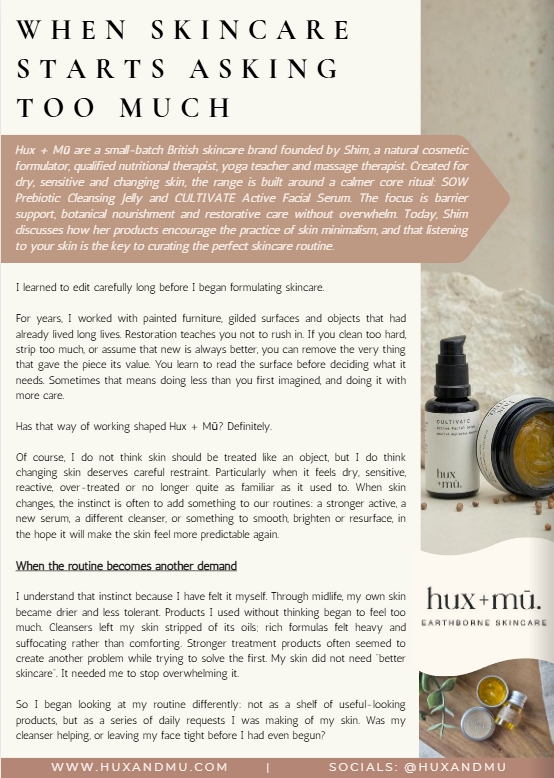
Article by Shim, Founder of Hux + Mū – as featured in Issue 10 of Beauty Folio Magazine
I learned to edit carefully long before I began formulating skincare.
For years, I worked with painted furniture, gilded surfaces and objects that had already lived long lives. Restoration teaches you not to rush in. If you clean too hard, strip too much, or assume that new is always better, you can remove the very thing that gave the piece its value. You learn to read the surface before deciding what it needs. Sometimes that means doing less than you first imagined, and doing it with more care.
Has that way of working shaped Hux + Mū? Definitely.
Of course, I do not think skin should be treated like an object, but I do think changing skin deserves careful restraint. Particularly when it feels dry, sensitive, reactive, over-treated or no longer quite as familiar as it used to. When skin changes, the instinct is often to add something to our routines: a stronger active, a new serum, a different cleanser, or something to smooth, brighten or resurface, in the hope it will make the skin feel more predictable again.
When the routine becomes another demand
I understand that instinct because I have felt it myself. Through midlife, my own skin became drier and less tolerant. Products I used without thinking began to feel too much. Cleansers left my skin stripped of its oils; rich formulas felt heavy and suffocating rather than comforting. Stronger treatment products often seemed to create another problem while trying to solve the first. My skin did not need “better skincare”. It needed me to stop overwhelming it.
So I began looking at my routine differently: not as a shelf of useful-looking products, but as a series of daily requests I was making of my skin. Was my cleanser helping, or leaving my face tight before I had even begun?
Was I adding products because they had a clear role, or because I was anxious that I was not doing enough? This is where I think the idea of skin minimalism becomes useful, but only if we take it beyond the look of a simplified shelf.
A smaller routine is not automatically a better one. It only becomes better when it has been edited with care. For me, that means understanding what each product is doing, what it is asking of the skin, and whether it is practical enough to use consistently on ordinary mornings and tired evenings.
Many of us are not short of products. We are short of clarity.
Skin is not fixed from one season of life to the next. It responds to weather, sleep, stress, nutrition, medication, environment and hormonal rhythm. Across the menstrual cycle, during pregnancy and postpartum, through perimenopause, menopause and beyond, our skin may ask for something different from what it once tolerated easily.
For some people, that change shows up as dryness. For others, it is sudden sensitivity, congestion, redness, rough texture, dullness, or a feeling that products no longer behave as expected.
It can be frustrating, especially if skincare has always been something you felt fairly confident with. The temptation is to keep searching for the next answer. I think it is often more helpful to look at the foundation first.
A careful edit begins at the sink
Cleansing is easy to underestimate because it feels like a functional step. It happens quickly, often when we are tired. But for dry, sensitive or hormonally shifting skin, cleansing can decide how the rest of the routine feels. If skin feels tight after washing, I always think it is worth pausing there.
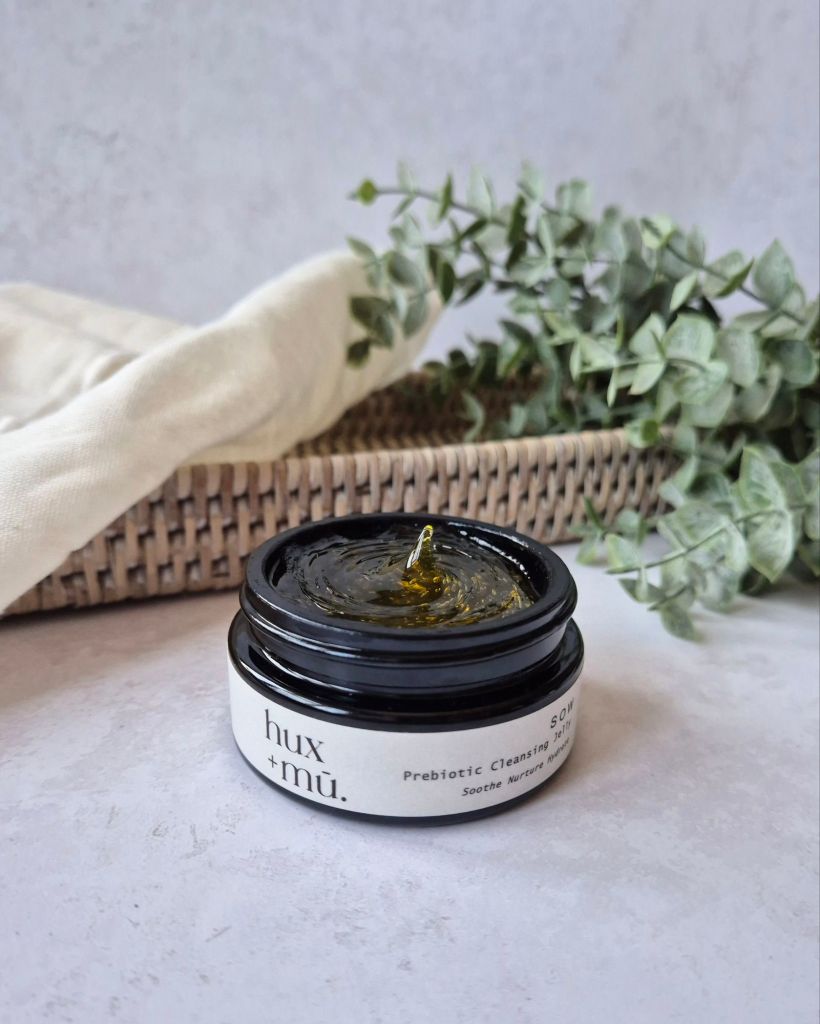
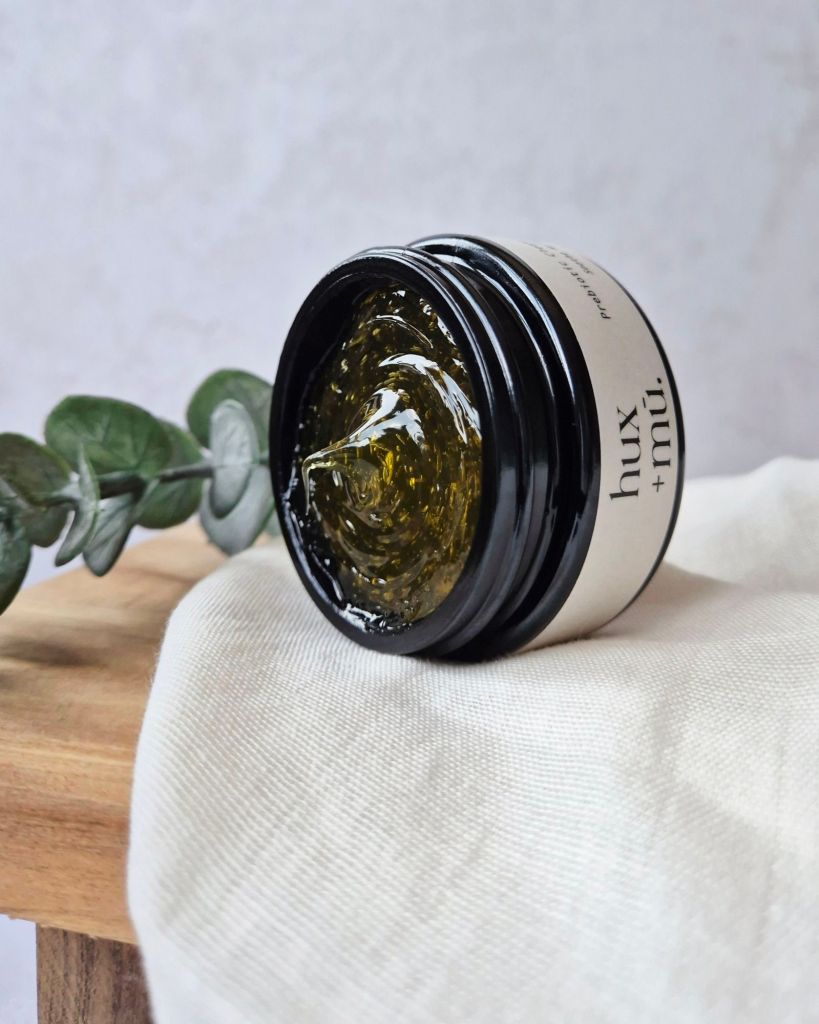
When I created SOW, I wanted a cleanser that could remove makeup, SPF and the day without leaving skin feeling bare. I also knew I did not want a routine that required a separate oil cleanse, a second cleanse and then extra hydration simply to recover from the cleansing step. Most evenings are not set up for that, and sensitive skin does not always thank us for doing more.
That is why the formula became a smooth jelly texture that warms and melts on contact with skin, captures oil, makeup and daily build-up, then turns to milk with water so it can be rinsed or removed with a soft cloth. The prebiotic story matters here, as does the hydration support from glycerin, marshmallow root and saccharide isomerate. But the real point is simpler: cleansing should not be the moment your skin starts asking to be repaired.
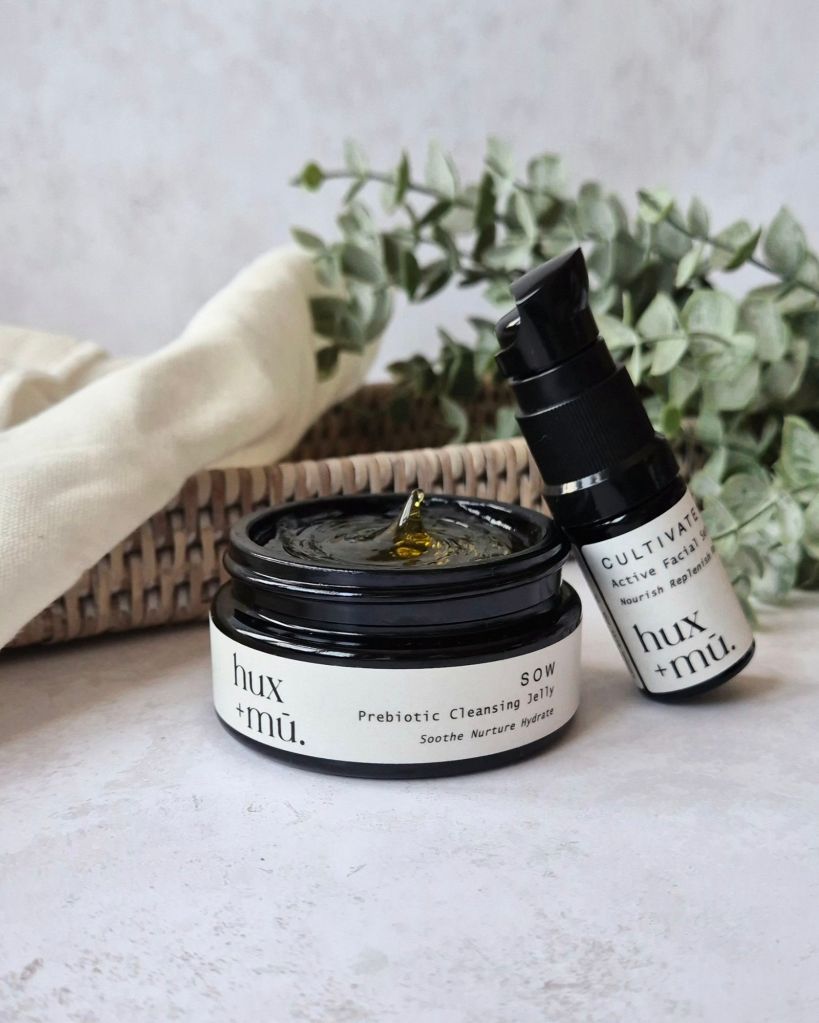
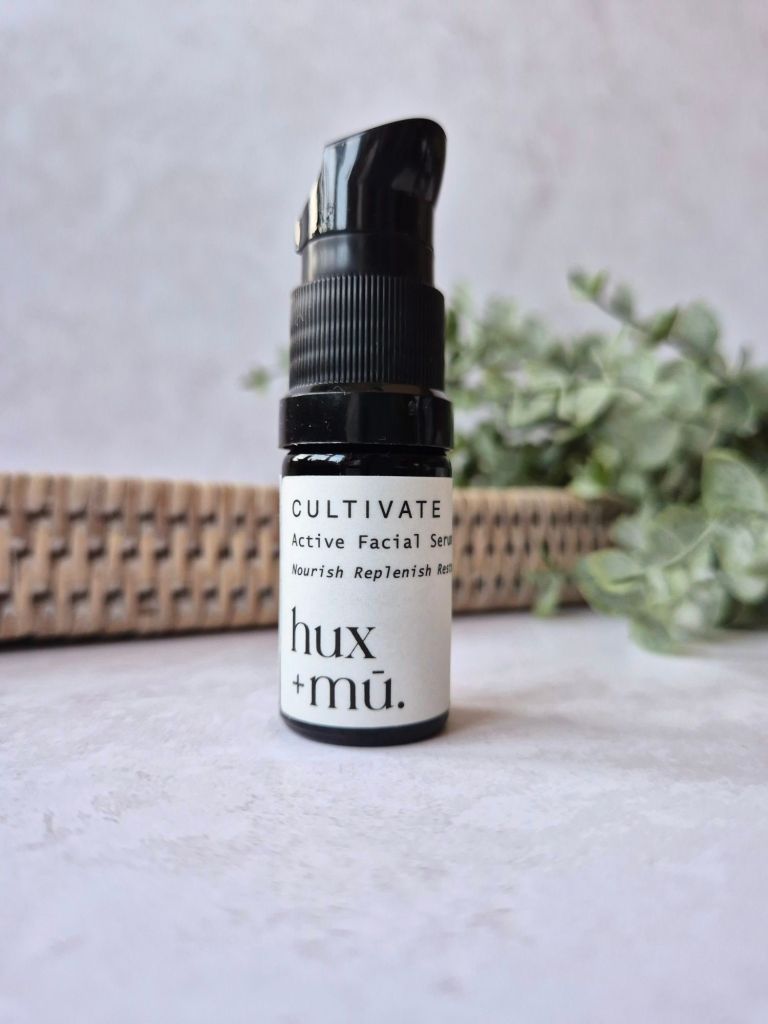
The same thinking shaped CULTIVATE. I did not want the replenishing step to feel like another treatment phase. By the time many women reach their forties and fifties, they have often tried enough strong products to know that intensity can be overrated. Others are younger, but are already tired of cluttered routines,product layering and the feeling that skincare has become one more thing to manage.
I wanted a formula that gave skin lipid-rich support, antioxidant care and a more settled feeling, without turning the evening routine into another piece of homework. Seed oils, ceramides, squalane, CoQ10 and bakuchiol all have their place, but only because they are doing something useful. The formula is not there to impress with a long ingredient list. It is there to help skin feel better supported, day after day.
A formula is a set of decisions
Natural skincare is often spoken about through ingredients, and of course ingredients matter. Their quality, compatibility and function all shape how a product behaves on the skin. But a formula is also a set of decisions about what to leave out, how something should feel when the skin is tired or unsettled, and whether it is useful enough to help someone stay consistent. These are the questions I ask when I formulate. They are also useful questions to ask of a routine.
A careful skincare edit does not have to mean throwing everything away and starting again. It may simply mean looking at the products you use most often and asking whether they still serve your skin as it is now.
Is your cleanser leaving your skin comfortable, or do you feel tight afterwards? Are you using exfoliants because your skin genuinely benefits from them, or because you feel you should? Are you layering several products that all promise glow, but ending up with skin that feels more reactive? Is your routine simple enough to repeat when you are tired and have very little interest in doing anything elaborate?
These questions are not about restriction, they are about usefulness.
For some people, the right edit may still include several steps. For others, it may mean returning to the basics for a while: a cleanser that respects the skin barrier, one replenishing product that supports softness and comfort, and SPF in the morning. The number of products matters less than whether the routine is coherent. Hux + Mū was created from that place.
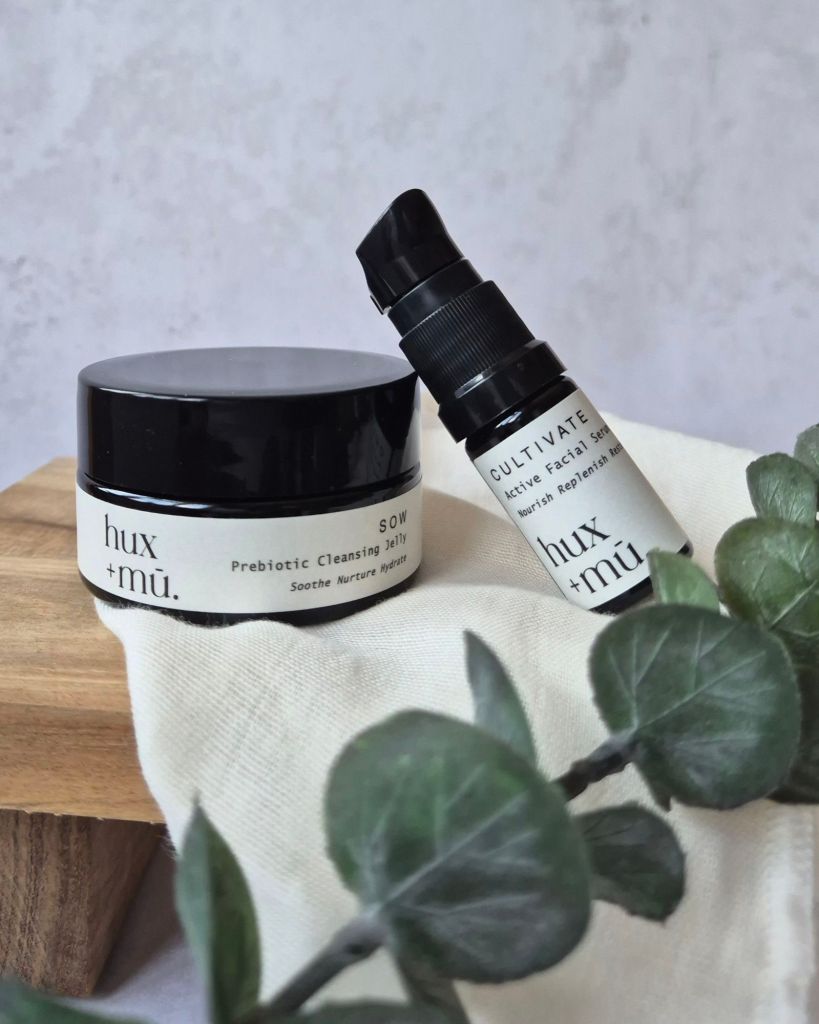
The range is deliberately small, built around SOW Prebiotic Cleansing Jelly and CULTIVATE Active Facial Serum as the core ritual. The idea is not to suggest that every woman only ever needs two products. Skin is personal, seasonal and responsive. There may be days when you want a mist, a moisturiser, an SPF, or a more targeted product. But when the foundation is clear, those additions become choices rather than a scramble for answers.
For me, skin minimalism is not about having the fewest products. It is about knowing why each one is there. That is where my restoration background still quietly sits. Not as a story I return to for decoration, but as a way of making decisions. Look first. Do not overwork what is already fragile. Support what needs support. Leave out what does not help.
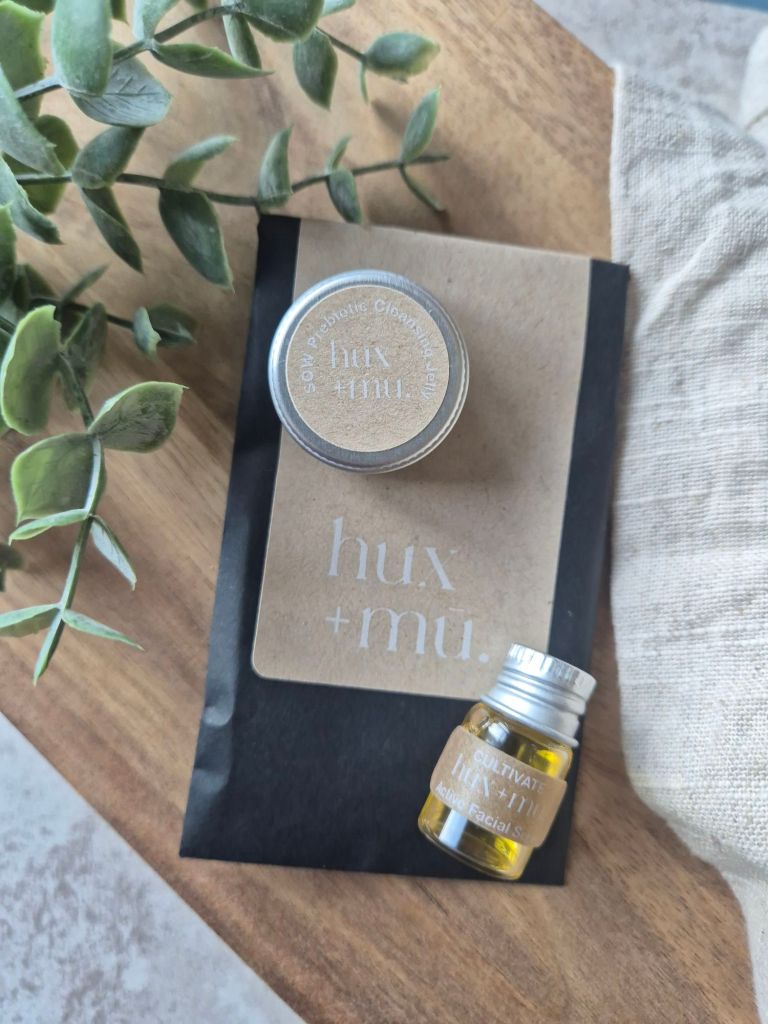

If any of this resonates, you are welcome to explore the Hux + Mū core ritual: one ritual, with three gentle ways to begin. Choose the Discovery Duo if you would like to try the textures first, Mini Mū if you would like a little more time with the routine, or the full Signature Ritual if you feel ready to settle into the complete ritual.
As a small welcome for Beauty Folio readers, you can use BEAUTYFOLIO10 for 10% off your first order.
Thank you to Shim for this wonderful article about Skin Minimalism. You can find more about Hux and Mū s range on their website, and get 10% off with the code BEAUTYFOLIO10.
You can find this article, along with my recommedations, in the latest issue of Beauty Folio Magazine here.

